
Walking & Weight Balance
The Quiet Work of a Morning Walk: Steps, Energy Balance, and What the Numbers Show
Eleanor Whitfield
·
·
9 min read
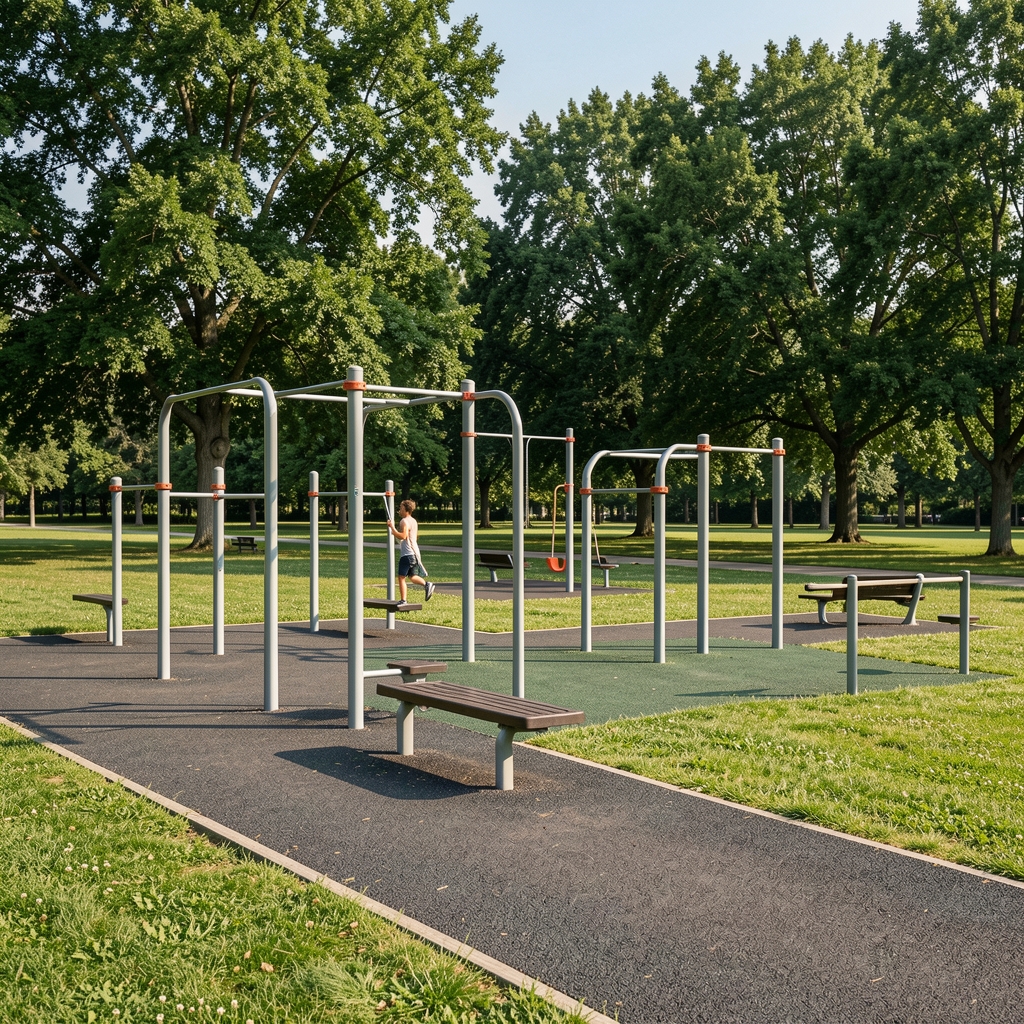
London has more park land per resident than almost any major city in Europe. Millions of people live within fifteen minutes of a green space large enough to walk a circuit. Yet park-based movement as a deliberate, structured element of a weekly activity routine remains something of an underexplored topic in the discussion of low-impact exercise for weight balance — perhaps because its accessibility makes it easy to take for granted, or perhaps because it does not fit neatly into the language of performance and measurement that surrounds most fitness discourse.
The effect of outdoor environment on the subjective experience of exercise is well-documented. Studies using real-time reporting of perceived exertion and mood during exercise consistently find that outdoor settings — particularly green spaces with natural features such as trees, water, and varied terrain — are associated with lower perceived effort at equivalent physical outputs compared with indoor treadmill environments or urban streetscapes.
This lower perceived effort matters for habit formation. Activities that feel effortful relative to their benefit are more likely to be avoided when competing demands arise. Activities that feel manageable, pleasant, or mentally restorative alongside their physical function are more likely to be protected in a busy week. The park walk occupies a position where the physical output and the perceived effort are misaligned in a favourable direction — it produces more energy expenditure than it feels like it costs.
Research by Thompson Coon and colleagues at the University of Exeter's European Centre for Environment and Human Health found that exercising in natural environments was associated with greater feelings of revitalisation, increased energy, and positive engagement compared with exercising indoors, alongside reduced negative states. Participants in the natural-environment group also reported greater intention to repeat the activity — a finding directly relevant to habit sustainability over multi-week periods.

The research on physical activity and weight balance consistently distinguishes between total weekly volume and the pattern of that volume across the week. A person who walks forty minutes every day accumulates approximately 280 minutes per week. A person who walks 280 minutes in a single weekend session accumulates the same total but in a different temporal pattern. The metabolic, behavioural, and habit-formation implications differ between these two approaches.
For the purposes of everyday activity and energy balance, daily or near-daily frequency is associated with more stable weight outcomes in observational cohort data than equivalent volume accumulated in fewer, longer sessions. The mechanism appears to involve both the metabolic effect of repeated activity and the behavioural effect of habitual frequency — the activity becomes part of the daily rhythm rather than a scheduled event, and is therefore less susceptible to cancellation under pressure.
Park-based movement lends itself naturally to a reliable weekly rhythm because parks are accessible, free, require no booking, and impose no minimum session duration. A twenty-minute walk on a Tuesday evening after work, a forty-minute circuit on a Saturday morning, and a fifteen-minute stroll on Sunday represent a total of 75 minutes across three days — modest but consistent, and achievable without disrupting other commitments.
"The park walk occupies a position where the physical output and the perceived effort are misaligned in a favourable direction — it produces more energy expenditure than it feels like it costs."
Field notes collected by Galvorn Notebook writers over the past twelve months document the outdoor routines of several London-based readers who have maintained a park-based movement habit for periods ranging from four months to just over two years. The observations are qualitative rather than controlled, but they reveal consistent patterns.
The most durable outdoor routines share several characteristics. First, a fixed route or a small set of familiar routes — two or three circuits in the same park or parks — rather than an expectation of variety. Variety in exercise is often cited as a motivator, but the field observations suggest that the opposite holds for habitual low-intensity outdoor activity: familiarity reduces the decision load and allows the walk to begin with minimal planning. The route becomes automatic, freeing attention for other things.
Second, a flexible duration standard. Participants with durable routines describe a minimum acceptable session length — typically fifteen to twenty minutes — and a preferred session length of thirty to forty-five minutes. On days when time or energy is limited, the minimum length preserves the habit. The routine does not require meeting the preferred length to count as completed. This flexibility against a lower bound, rather than an all-or-nothing definition of what constitutes a session, appears to be a significant factor in long-term adherence.
Third, a decoupling of the outdoor walk from other activities. Participants who attempted to walk to specific destinations — a shop, a friend's address, a work meeting — reported lower routine adherence than those whose park visits were purposeless in the destination sense. The walk as a destination-free activity, rather than a means of getting somewhere, appears to reinforce its identity as a recovery-and-movement session rather than a logistics solution, making it more resilient when the logistical need no longer exists.
A recurring finding in the Galvorn Notebook field observations, which aligns with broader research on outdoor activity and total daily movement, is that a park visit in the morning or early afternoon tends to be associated with higher total daily step counts than on days without a park visit — even accounting for the steps taken in the park itself.
This pattern is difficult to attribute mechanistically, but several plausible explanations present themselves. Outdoor activity in green space is associated with mood and energy improvements that may lower the barrier to subsequent movement during the day. The morning park walk establishes a movement orientation that makes incidental activity — short walks to shops, stair use, standing during calls — more likely to occur. And the deliberate act of making time for movement in the morning may signal a daily commitment to activity that influences subsequent choices.
Whatever the mechanism, the observational data suggests that park-based movement does not simply add its own step count to the daily total — it appears to shift the entire distribution of daily movement upward. For weight balance, this total-day effect may be as significant as the park session itself.
Most London boroughs have at least one substantial park within a fifteen-minute walk of the majority of residential addresses. The Transport for London walking-time map consistently shows park access as one of the more equitably distributed public resources across inner London — a characteristic that makes outdoor activity genuinely accessible across a wide range of household circumstances and schedules.
For establishing a park-based routine from a low baseline of outdoor activity, the most consistent recommendation from the habit-formation research and from the Galvorn Notebook field observations is to begin with a frequency commitment rather than a duration or intensity target. Committing to visiting the park four times per week — regardless of how long each visit lasts — tends to produce more durable routines over twelve weeks than committing to a specific session length such as thirty minutes.
This frequency-first approach is consistent with the broader evidence on low-impact movement habit formation: regularity is the variable most strongly associated with long-term adherence, and it is the variable that most directly supports the energy-balance contribution of outdoor activity over time. The park does not need to be used intensively. It needs to be visited consistently.

Eleanor has written about everyday wellness and urban movement for over eight years. Her work draws on published research in sports science and behavioural habit formation. She contributes the majority of feature articles to Galvorn Notebook and oversees editorial standards.
More from this author